The Blind Rib Taste Test: When My Offset Smoker Went Head-to-Head with the In-Laws' Gas Grill
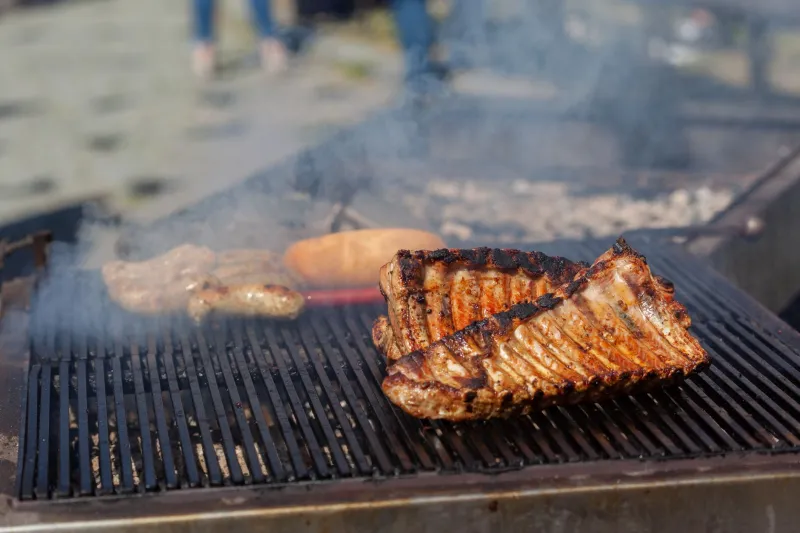
Every family has one. That relative who thinks a propane tank and a bottle of store-bought sauce constitute barbecue. Mine is my brother-in-law, Dale, a good man with terrible opinions about meat. For three straight summers, Dale has watched me babysit a stick burner through the July heat and asked the same question: "Why don't you just use the grill? Same thing, way faster."
This year, I stopped arguing and started planning. A blind taste test. Ribs versus ribs. His gas-grilled, sauce-slathered rack against my dry-rubbed, hickory-smoked spare ribs, cooked low and slow for six hours. Secret ballots. No mercy.
Setting the Rules Before the Trash Talk Started
I wrote the rules on a index card and taped it to the cooler, mostly so nobody could claim the game was rigged after the fact:
- Two racks, trimmed the same way, from the same butcher, bought the same morning.
- Dale cooks his his way. I cook mine mine way. No coaching from the peanut gallery.
- Every rib gets sliced, plated on the same blue paper plates, and labeled only "Rib A" and "Rib B."
- Everybody at the reunion votes. Kids included. Grandma Peggy gets two votes because she paid for the pavilion.
Dale agreed to all of it, which surprised me. Then he showed up with a squeeze bottle of Sweet Baby Ray's and a grin that said he'd been waiting for this fight.
Six Hours of Fire vs. Twenty Minutes of Flame
Here's what people don't understand about this matchup until they've lived it. Dale's cook took about twenty-five minutes of actual work. Mine took all morning.
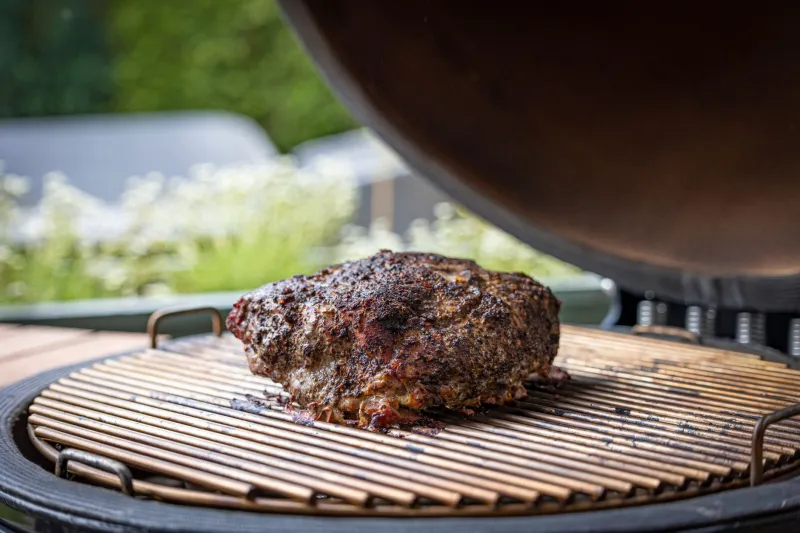
I pulled my spare ribs from the fridge at 7 a.m., trimmed the membrane, and hit them with a simple rub — equal parts kosher salt and coarse black pepper, a heavy shake of paprika, brown sugar, garlic powder, and a pinch of cayenne. By 8:15 the offset was holding steady around 235°F with a mix of oak and hickory, and the ribs went on bone-side down.
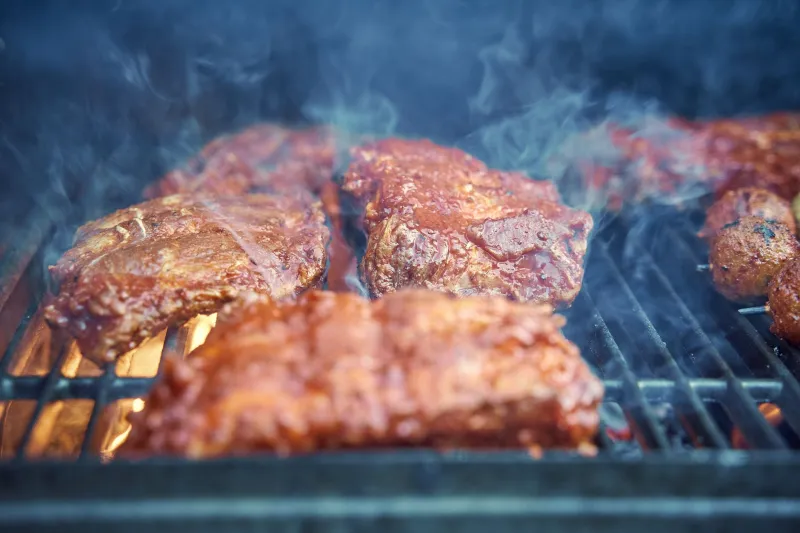
The next six hours were the usual low-and-slow meditation: splitting wood, chasing temperature swings when the sun came out, spritzing with apple juice every forty-five minutes, wrapping at the three-hour mark when the bark looked right. Dale, meanwhile, flipped burgers, told a story about his fantasy football league, and grilled his ribs in about twenty minutes with a glaze so thick you could patch a tire with it.
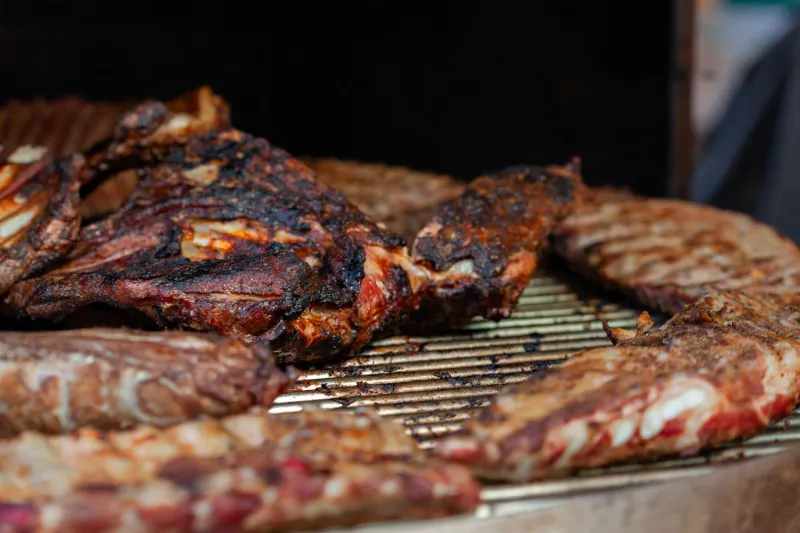
By noon, both racks rested in foil. One had a mahogany bark and a smoke smell that made the neighbors wander over under false pretenses. The other was glossy, red, and shiny as a bowling ball.
The Voting Cards and the Verdict Nobody Expected
I cut each rack into single bones, arranged them on two matching platters, and let the crowd loose. Thirty-one family members. Paper cards. Two boxes: one labeled with a smoker drawing, one with a grill drawing, because half the crowd can't read my handwriting.
The tally, counted by my niece under adult supervision:
- Smoked ribs: 17 votes
- Gas-grilled ribs: 14 votes
Seventeen to fourteen. I won by three votes, two of which were my own children, who I'm fairly sure voted for the smoke smell and not the meat.
Dale was insufferable about it. "Three votes," he kept saying, holding up three fingers to anyone who'd look. "Six hours of your life for three votes."
He wasn't wrong, and that's the part worth sitting with.
What the Numbers Actually Say About Barbecue in America
I've chewed on this result for a few weeks now, and I think the lesson is bigger than one cookout.
First: low and slow won, but not in a landslide. The smoked ribs got consistent praise for tenderness and depth of flavor — "tastes like a campfire in a good way" was my favorite comment. But the gas-grilled ribs pulled serious support for one reason: the sauce. Sweet, sticky, familiar. Half my family grew up on sauced ribs from backyard grills and chain restaurants, and that flavor is baked into their idea of what ribs are.
Second: texture carried my rack, but the smoke flavor split the room. Two cousins said the hickory was "a little much." A little much. I nearly disowned them on the spot, but they have a point. Smoke is an acquired register, and not everybody's palate lives there.
Third — and this is the part I'd tell any backyard cook: the gap between good grilled and great smoked is smaller than the gap between bad and good of either. Dale's ribs were cooked properly. Juicy, not overdone, sauced with confidence. If he'd dried them out, this would've been a blowout. Because he didn't, it was a coin toss with a smoke-flavored edge.
Four Things I'd Tell Any Pitmaster Planning Their Own Showdown
If you want to run this experiment at your next cookout — and you should, it's the most fun I've had with a clipboard in years — here's what I learned:
- Control the meat, not the method. Same butcher, same cut, same day. Otherwise the argument dissolves into "your ribs were better" instead of "your method was better."
- Blind plates only. The moment people know which rack is yours, the vote becomes a referendum on you, not the food. My wife voted against me purely on principle. Blind cards fixed that.
- Don't over-sauce your side. If you're representing the low-and-slow camp, let the bark and smoke do the talking. A dry rib loses to a glazed rib at any family function in America. Ask me how I know.
- Be ready to lose. Or, worse, to win by a whisker. Either outcome teaches you something that a hundred cookoffs won't: barbecue isn't just technique, it's expectation. People bring their childhoods to the table.
So Does Low and Slow Win Hearts?
Here's my honest answer after the smoke cleared: it wins the room, but it doesn't always win the vote. What it wins is something else — the smell that pulls people off their lawn chairs, the questions about your fire management, the kid who asks if he can watch you split wood next time.
Dale and I are running it back at Labor Day. He wants to add a third entry: his new pellet grill, which he bought the day after the vote, presumably out of spite. I've agreed, because deep down, every pitmaster knows the truth. More barbecue at the table is never a bad result.
Even if Grandma Peggy votes for the gas grill again.