Prime Rib's Quiet Plateau: What to Do When the Smoker Stalls at 120°F
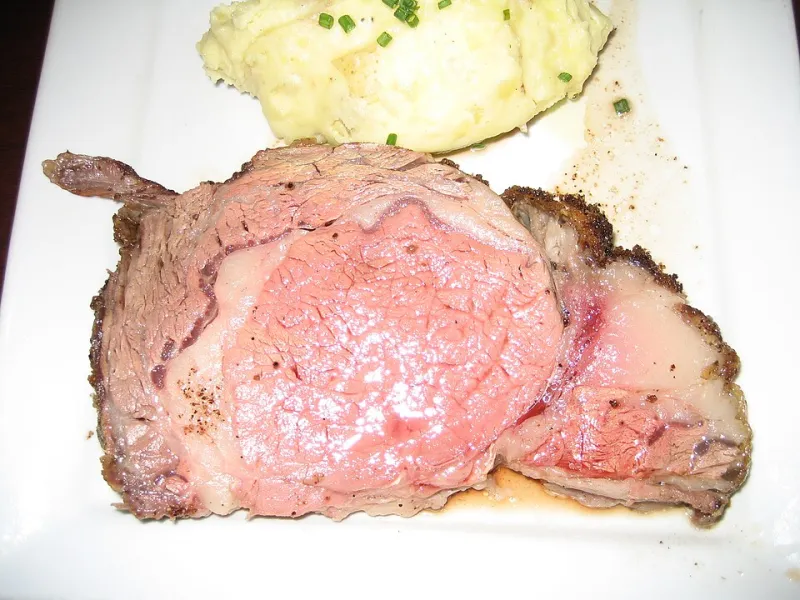
Photo: User:Promking, CC0, via Wikimedia Commons
It's the 2026 holiday season, you've got a prime rib on the smoker, the kitchen smells like rosemary and oak, and the thermometer has been creeping up like it's got all the time in the world. Then it hits 118°F, maybe 122°F, and just… stops. Fifteen minutes go by. Then twenty-five. You check the probe. You check it again. You open the lid, because apparently you're the kind of person who opens the lid. The readout doesn't move much. Welcome to the holiday stall—the quiet little plateau that spooks more prime rib cooks than any snowstorm ever could.
The Stall Isn't a Brisket Exclusive
Most backyard cooks know the brisket stall: that long, sweaty stretch somewhere around 150°F to 170°F when the internal temperature refuses to cooperate and you start questioning your life choices. Prime rib can stall too, just earlier and often more subtly. The mechanism is similar—evaporative cooling—but the roast is different. You're not working with a collagen-heavy packer brisket that needs hours to break down. You're cooking a lean, expensive, relatively tender roast that you want to pull at medium rare. That changes the timing, the stakes, and the way you should respond.
When moisture evaporates from the surface of the meat, it carries heat away. That's evaporative cooling, and it's why you sweat when you're hot. On a smoker, the roast is basically doing the same thing. The surface stays cooler than the surrounding air, and the internal temperature climb flattens out. On a prime rib, this can happen around 115°F to 125°F, especially on a cool, dry day with a breeze. It's physics, not failure.
Why 120°F Is the Magic Number (and Why It's Not Really Magic)
Prime rib doesn't have the same connective tissue load as brisket, so it doesn't need a long collagen melt. But it does have a fat cap, plenty of surface moisture, and a shape that exposes a lot of area to moving air. As the roast warms, the fat begins rendering, moisture migrates to the surface, and the smoker's airflow does what airflow does. The result is a plateau that can last twenty minutes, forty minutes, or—on a windy November day—close to an hour.
The exact temperature isn't sacred. Some roasts stall at 110°F, some at 128°F. What matters is recognizing it for what it is: a temporary slowdown, not a sign that your fire died or your meat is broken. If your smoker is holding steady and your probe is in the right spot, the roast is still cooking. It's just taking a breather.
A Timing Plan That Leaves Room for the Plateau
Prime rib is not the cut to cook by the seat of your pants, especially when guests are arriving and the mashed potatoes are already warming. Build a buffer into your plan.
For a 6- to 8-pound bone-in roast, figure on three to four hours at 225°F to 250°F, plus a stall, plus a rest. That means starting roughly five hours before you want to sit down. If the roast finishes early, you can hold it in a 140°F oven or a preheated cooler for a while. If it stalls, you've got room to breathe.
Pull the roast at 125°F for medium rare, 130°F for medium-rare-plus, or 135°F for medium. Carryover cooking will add another five to ten degrees while it rests. Let it rest for at least thirty minutes, loosely tented with foil. If you're doing a reverse sear, do it after the rest or right at the end, depending on your setup—but don't skip the rest.
Wrapping, Boating, or Leaving It Alone
Here's where prime rib differs from brisket. You can wrap a brisket in butcher paper and nobody blinks. Wrap a prime rib too early and you risk steaming the crust you worked for. The fat cap and the seasoned surface are part of the show.
My default is to leave it alone unless the stall runs past forty-five minutes or the clock gets tight. If you need to move things along, try a foil boat: wrap the bottom and sides, leave the top exposed. That shields the roast from direct heat and helps push through the plateau without turning the crust to mush. Butcher paper is another good option. Avoid a full foil wrap unless you're in full-on rescue mode and you've accepted a softer surface.
And resist the urge to crank the heat the second the stall hits. A jump to 300°F can dry out the exterior before the center catches up. If you do bump the temperature, do it modestly—say, 275°F—and give it twenty minutes before you make any more decisions.
The Rest Is Part of the Cook
A prime rib that comes off the smoker at 125°F is not finished. The rest is where the juices redistribute and the carryover brings the center to its final temperature. Skip the rest and you'll lose half of them to the cutting board. Thirty to forty-five minutes is ideal. Tent it loosely—don't wrap it tight—and leave it alone.
If your roast stalls at 120°F and you panic-crank the heat, you'll likely overshoot the rest. If you pull it at 135°F thinking it'll come down, you'll end up with gray meat. Trust the process. The stall is not the enemy. Overreacting to the stall is.
Troubleshooting Checklist
- Check your probe placement. Make sure the tip is in the center of the roast, not in fat, bone, or a pocket of air. Verify with an instant-read in a second spot.
- Verify your smoker temp. A built-in dial can lie. Use a separate thermometer at grate level.
- Don't open the lid every ten minutes. Every peek drops the chamber temperature and adds time.
- Keep the water pan in play if you use one. Humidity affects evaporative cooling. A dry chamber can exaggerate the stall.
- If the stall runs past an hour, bump the heat to 275°F. Give it twenty minutes before adjusting again.
- Leave the crust alone. No spritzing every fifteen minutes. Every forty-five minutes is plenty if you spritz at all.
The Holiday Table Doesn't Care About the Clock
Here's the thing about prime rib: it's a forgiving roast if you give yourself a buffer and resist the urge to micromanage. The stall at 120°F is not a crisis. It's the roast telling you it's working. Pour a cup of coffee, check the fire, and let the smoker do its job. The 2026 holiday dinner will still come together. And when someone asks why the roast took so long, you can tell them it hit the quiet plateau—and you knew exactly what to do.